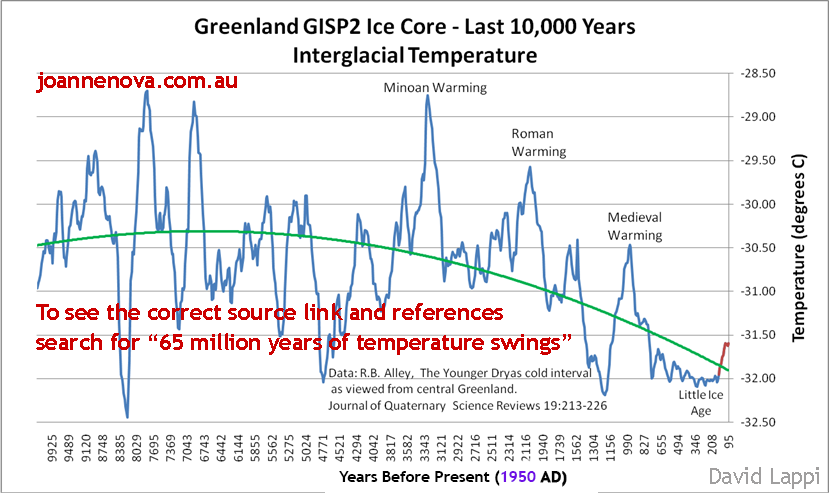
Good graphs here showing past warming with some commentary...,.
Full article here.....
http://www.rationaloptimist.com/blog/best-shot
The best shot?
UPDATE: David MacKay's letter is now up in a separate post here
Some weeks ago I wrote an article for The Times about why I no longer find persuasive the IPCC's arguments that today's climate change is unprecedented, fast and dangerous.
I was delighted to receive a long and courteous letter from David MacKay, the chief scientific advisor to Britain's Department of Energy and Climate Change. With his permission I am publishing my reply to that letter. I would put his letter here too (again he agrees), but I only have a hard copy of it, so that will have to follow when he has time to send me a soft version.Now done.
The remarkable thing about this exchange is that far from weakening my doubts about the IPCC case, it has strengthened them. The letter explains why. Essentially, I have realised that almost the only weapons left in the alarm locker are the retreat of the Arctic sea ice and an event that happened 55m years ago and was probably not caused by CO2 at all. Everything else -- the CO2-temperature correlation in the Antarctic ice core, the hockey stick, storm frequency, phenology, etc etc -- no longer supports the argument that something unprecedented in magnitude or rate is happening. Remarkable.
Here is my letter:
Dear David
I am honoured that you liked my book and I liked yours very much indeed: a brilliant and necessary contribution to the debate. Though it arrived late in my writing process, I managed to squeeze in several references to it in the penultimate chapter of mine.
Thank you for taking the trouble to give such a detailed reply to my Times article – much longer than the constraints of the Times op-ed page allowed for me! I shall now indulge in a longer reply. It is certainly nice that the political `climate’ (sic) now allows articles like mine to receive serious replies, rather than accusations of heresy or sin or threats of prosecution as a criminal against humanity. I appreciate that very much. I surmise from your covering note that perhaps your letter is circulated more widely among DECC colleagues and I would be glad for you to circulate this reply, not least to the secretary of state who showed you my article. I shall post this letter on my blog.
I am surprised to find that I agree with much of your letter, but it changes almost none of my conclusions. How can this be? The gap between the science and how it has been presented is huge. This is as much the fault of bodies like the Royal Society, which should have been a brake on politically inspired extreme statements but was not, as it is of the media. You say scientists know how big the uncertainties are and that the failure to ensure that uncertainties are reported has contributed to the problem. I agree and I wish that the science establishment had paid this issue more attention. They allowed and encouraged their spokesmen to peddle the very opposite impression.
Consider this statement for example: `Earth's climate can only be stabilized by bringing carbon dioxide emissions under control in the twenty-first century.’ That is the opening sentence of a paper in Nature Geoscience last month. It is shocking that it got past the editors and reviewers. After 4 billion years of climatic volatility, much of it not caused by CO2 but by orbital variations, solar cycles and so on, how on earth are we to `stabilise’ earth’s climate by adjusting just one forcing factor? I refuse to accept that the climate could ever be stabilised, let alone by adjusting one factor. That sentence has no place in a scientific journal.
Taking your points in turn, then:
You say most climate scientists are nicer than their caricature on the web. I agree, but so are most sceptics. The image of the politicised, right-wing, anti-science zealot fits some, of course, just as the reverse fits Jim Hansen, Bob Ward and Joe Romm, but the ones whose work I have got to know, such as Andrew Montford and Steve McIntyre are quite different. The polarisation of this issue is a real problem. I learned from writing about the nature-nurture debate that arguments get polarised because people only read their friends’ caricatures of their opponents’ works; it is vital that we all read all sides of the argument.
Next you criticise my argument that current warming is not `unprecedented’ by reference to the Arctic sea ice graph. But this only goes back to 1979! Blackpool’s Football League table position is unprecedented since 1979. In a brief period of warming, of course the warming is unprecedented. You will know the ample anecdotal evidence that Arctic sea ice retreated just as much in the 1920s and 1930s: remember `Warming island’ for example. There is also good evidence from wave-made beaches and driftwood in Northern Greenland of probably ice-free summer months in the Arctic 7,000 years ago. A study published in the journal Quaternary Research of sea sediment cores in the Chukchi Sea shelf in the Arctic Ocean concluded that `during the middle Holocene the August sea surface temperature fluctuated by 5°C and was 3-7°C warmer than it is today'. (Incidentally, I am keen to see a proper test of the hypothesis that black carbon is the main cause of the Arctic sea ice summer retreat of recent years and that cleaning up Chinese coal power stations will reverse the trend. The argument seems quite plausible – and it might explain why Antarctic sea ice has been expanding during the same period -- but it needs a test.)
To be honest, whenever that sea-ice graph is used as an argument, I become a little bit more sceptical. If that is the best evidence of something unprecedented, then the case must be weaker than I thought. It is a change that is not even likely to threaten human or animal livelihoods: even with a total late-summer melt (I presume you do not belong to the school of thought that the ice could fail to reform in winter), there is no great albedo feedback at such latitudes because of the angle of the sun in August, and polar bears will expand their range further north or will survive ice-free summer months onshore as they do already in Hudson’s Bay, on Wrangel island and parts of Svalbard (where one once walked round my tent while I slept).
Then you say that if I mean `not unprecedented on 100m year timescales’... But those are not the only two options! I mean not unprecedented in centuries and millennia, ie in human history. It is hugely relevant whether the warming of 1910-40 was as fast as 1980-2010 (it was). It is hugely relevant if the climate was as warm in 1100 AD as now (it probably was) both in attributing cause and in making conclusions about sensitivity.
You will have seen this graph, one of many now making it amply clear that the warmth of the Holocene optimum, peaking about 7,000 years ago, was both global in extent and considerably warmer than today:

And this: